

Ok it feels kind of funny for me to be writing this article about Wise and Revolut in Canada because I’m Canadian. BUT I moved semi-permanently to New Zealand several years ago and shut down all my banking stuff in the Great White North. So now, when I visit home, I’m converting NZD to CAD and using international currency cards like an outsider. After using and comparing Wise vs Revolut for Canada (and around the world), here’s what I recommend to visitors.
This post may contain affiliate links. Bookings or purchases through these links generate a small commission for me at no extra cost to you. Thanks for your support!
Cut to the chase, which is better? Wise vs Revolut for Canada
In the Wise vs Revolut for Canada showdown, they’re actually about equal for spending on the day to day. But I’d go with Wise if you’ll need to do any transfers (sending or receiving) with Canadians. However, Revolut is better if you really want to use a shared account with your travel partner. When you’ve made up your mind, I have sign-up links with referral codes down below.
Quick note before you keep reading: Revolut isn’t open to Canadian residents, so this guide is for visitors only.
A quick "What are Wise and Revolut?" for the uninitiated
If you’re not already familiar, Wise and Revolut are both app-based, multi-currency accounts with a debit card attached. They let you convert your home currency into foreign money that you can “hold” in several digital wallets.
For example, you might have accounts for Thai baht, Indonesian rupiah, British pounds, and Canadian dollars all on the go at the same time.
And there’s no real limit. You can keep like, 40 currencies on the go if you want. (Though that seems like a nightmare to me — I usually have maybe 5 going on each app at most.)
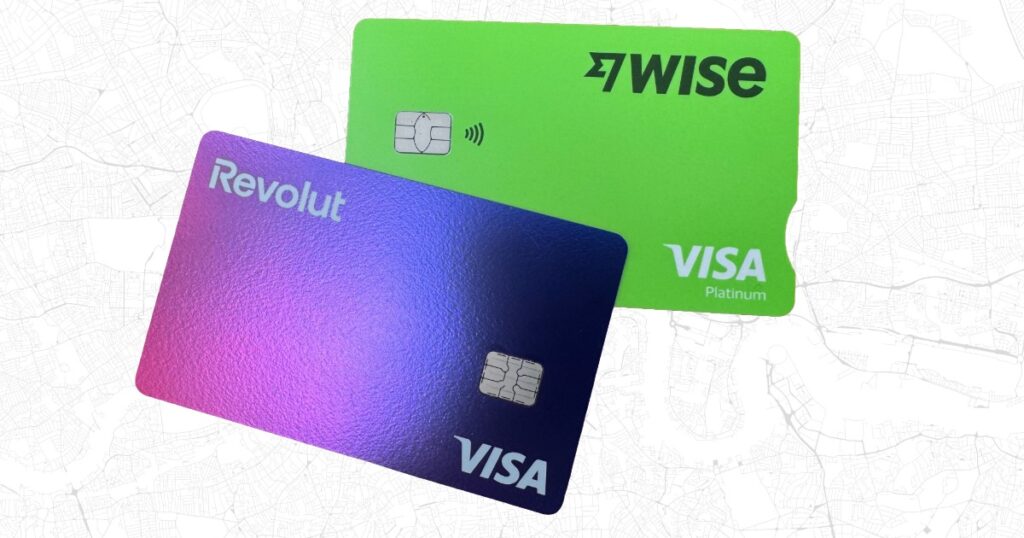
You top up the app from your regular bank account, convert your money into the currency you need, and then tap to pay like you would with any other card.
They’re basically made for travellers, because they let you skip the foreign transaction fees and poor exchange rates your home bank card or ATM would otherwise charge. Multi-currency cards like Wise and Revolut are a brilliant way to cut down on unnecessary fees for accessing your hard-earned travel money.
One exception where your bank card might still be worth using in Canada is if your bank is part of the Global ATM Alliance with Scotiabank. Then you can use ATMs without coughing up the $3-5 withdrawal fee.
If you do withdraw money with your bank card instead of Wise or Revolut, ALWAYS decline the ATM currency conversion. Your bank will do the conversion for you instead, and it will almost always be a better rate.
With Wise/Revolut, the ATM doesn’t manage the exchange, so it won’t even ask you this question and you can pull however many Canadian dollars you see in your account.
Comparing Wise vs Revolut for Canada trips
Here’s a quick look at how Wise and Revolut compare as multi-currency cards you can use to spend CAD in Canada.
| Feature | Wise | Revolut |
|---|---|---|
| Exchange rate | Mid-market rate plus a small fee that varies by currency pair | Mid-market on weekdays up to your plan's monthly limit; 1% extra on some weekend exchanges |
| Free monthly ATM allowance | UK£250 / US$250 / NZ$400 | Plan and country dependent (For example, UK Standard Plan: £200) |
| Loyalty points | None | RevPoints |
| Interac e-Transfer | Yes | No |
| Joint accounts | No | Yes |
Set up your Revolut or Wise card for Canada well before you start your trip. Opening the account only takes a few minutes, but you will also want to order a physical card, which will take maybe up to a week in the mail.
However, if you don’t get it all done in time or you simply don’t want an actual card, you can use virtual Wise and Revolut cards in your Apple Pay or Google Pay wallets. You only really “need” a physical card for withdrawing money at the ATM or big purchases that exceed the tap amount. (Usually around $250 in Canada in my experience, but there’s no official rule.)

Foreign exchange rates and fees with Wise vs Revolut
The main “thing” or benefit to Wise and Revolut is that they don’t charge a foreign transaction fee like most banks. Not in Canada nor anywhere else.
For example, my Westpac New Zealand bank charges 1.83% on every overseas purchase I make. So when I use Wise or Revolut, I skip that entirely.
Both multi-currency cards do still have some low foreign exchange (FX) fees, though.
Wise FX rates and fees
Wise converts at the mid-market rate (the one you’d see on Google or XE) and adds a small fee that varies by which currencies you’re converting. They’re often negligible amounts.
For example, when I convert NZD to CAD it’s 0.35%, and 0.45% when converting the other way from CAD to NZD.

Revolut FX rates and fees
Revolut also uses the mid-market rate (*on weekdays), up to a monthly limit that depends on your plan and country. On my Standard plan in NZ, it’s $2,000 month.
*On the free plan, there’s a 1% Revolut weekend exchange fee from Friday 5 PM to Sunday 6 PM Eastern Time (ET). I have beef with this, because trying to do money math is hard enough without throwing time math into the mix. Like I have no idea what’s going on in ET when I’m trying to convert some money on the other side of the world in NZST.
A 1% cut isn’t a big deal, but I just don’t like that it sort of requires me to plan ahead — that’s not who I am. It’s called a Fair Use Fee, but it feels like a Disorganization Tax.
Bank conversion fees Wise vs Revolut for Canada
Let’s say Wise shows 1 USD = 1.40 CAD, but your bank’s conversion rate is 1.35 CAD. That seems like a negligible difference, and if you were just buying something small, it would be.
But maybe you’re spending 2,000 USD over two weeks in Canada on fuel, food, and a stay at the Hôtel de Glace in Québec. At the Wise rate that’s about 2,800 CAD, and at your bank’s rate it’s 2,700 CAD, so you lose out on 100 bucks!
And that’s before the bank charges foreign transaction fees, which might be another 1-3%. So using a multi-currency card like Wise or Revolut does actually save you money in the long run for a trip, even if it doesn’t look like much at first glance.
I find Wise and Revolut almost always have the same mid-market rate — nearly exact. And it’s the same rate you’ll find on Google.

Comparatively, your bank’s rate isn’t as transparent and varies based on several factors. It’s hard to compare in real-time with Revolut and Wise, but you can safely assume it’s lower.
For example, Barclays in the UK charges another 2.99% for any purchases not in GBP. They have a comparison table on their website that shows their rate is worse than the mid-market, European Central Bank rate. This will be the case for most traditional banks around the world, though. (Not trying to single you out, Barclays.)
Cash & ATM fees in Canada
Tbh you barely need cash in Canada. I really think you could get away with doing a coast-to-coast road trip using card to pay for everything along the way. That said, it never hurts to travel with cash, and you’ll likely visit the ATM in Canada at least once.
Do Canadian ATMs charge fees for foreign cards?
Yes, there is an ATM withdrawal fee in Canada for foreign cards. So you get the unfortunate double whammy of the ATM fee plus whatever your card charges as a foreign transaction fee.
ATM fees in Canada range from about $3-5 for withdrawals on international cards. Even though you’re holding Canadian dollars (CAD), the ATM knows your card isn’t actually from a Canadian bank and will still charge a foreign transaction fee. It’ll tell you how much on the screen before you confirm and withdraw your cash.
Wise gives you a fee-free monthly allowance depending on where your card was issued. For example: GBP £250 / USD $250 / NZD $400. After you reach that limit, it charges 2.69% on cash withdrawals.
Your Revolut card for Canada ATM withdrawals has a similar system, but your monthly fee-free allowance depends on where your card was issued and what plan tier you’re on.
Here are some conditions for different Revolut cardholders depending on your country of residence: United Kingdom, United States, New Zealand, and Australia. The free Standard Revolut plan in the UK has a similar monthly allowance to Wise, at £200 per month, then 2% after the limit.

Points and rewards
One of the biggest downsides to using Wise or Revolut over a traditional bank card is that you don’t rack up as many (or sometimes any) points.
With Wise, I get nothing. But with Revolut I get to collect RevPoints.
Though RevPoints aren’t available to everyone, and I couldn’t find a solid list that shows me who’s able to get RevPoints. So instead, here’s the list of countries that support Revolut, and from there you can look into whether RevPoints are available to you. Unfortunately, for now, RevPoints aren’t available to US Revolut cardholders.
Example: Revolut RevPoints in New Zealand
For my New Zealand Revolut account, the Standard (free) plan offers 1 point per $16 spent, and the points are better if you go for a monthly subscription, down to 1 point per $1 spent if you’re on an Ultra plan.
You can redeem RevPoints in-app for things like flights, airport lounge access, hotels, gift cards, yadda yadda. Redditors generally agree that converting RevPoints to miles is the best way to redeem them.
For comparison, in NZ my Westpac Koru debit card gives me 1 Air New Zealand Airpoint ($1) for every $300 I spend. And my American Express Airpoints card is even better at 1 point for every $100.
The RevPoints value certainly isn’t Amex level, but they’re still worth collecting. (Note you have to opt in through the Revolut app, you don’t just automatically start collecting when you get your card.)
Here are some in-depth Revolut plan comparison guides for cardholders in New Zealand, Australia, and the United Kingdom.

Does Wise worth with Interact e-Transfer in Canada?
When I moved to New Zealand and closed all my Canadian bank accounts, I lost the ability to send an Interac e-Transfer. That was fine until I was back visiting Canada on a girls’ trip weekend and needed to send my half of the Airbnb to someone else.
Quick explainer to get you up to speed if you’re not Canadian: Interac e-Transfer is Canada’s go-to way to send money to a friend — everyone uses it. You use the person’s email or phone number and the money goes straight from your bank to theirs. It’s a bit like Venmo in the US. But only people with Canadian bank accounts can use Interac e-Transfer.
And Wise counts! I can manage it within the Wise app and it sends my money to their email address (no phone number option, but who cares). And on the reverse, they can just send an e-Transfer to my email address — as long as it’s the one registered to my Wise — and I receive the money as if I’m a real and true Canadian with a local bank account.

What I love is that the person I’m transferring with doesn’t even have to know what Wise is. (Trying to explain it to someone when you owe them money might freak them out and make them think you’re doing something shady. At least, that’s my fear.)
If you need to split costs with any Canadians (in Canada or abroad), the ability to send and receive Interac e-Transfers is maybe the biggest reason to use Wise.
Read more: My Top 10 Must-Have Travel Apps
What about Revolut for Interact e-Transfer?
You can use a Revolut card in Canada, but it doesn’t work with Interac e-Transfer. The easiest alternative is Revolut-to-Revolut payments by phone number or Revtag (your unique @username in the app). But then of course your friend needs to sign up for Revolut, too. (If they do, make sure you give them your referral link first!)
If they’re not into downloading a whole new app and creating an account to send or receive money, there’s always PayPal or good old fashioned cash. At least you can use your Revolut card at the ATM lol.
Chargebacks and disputes
It’s not often that you have to reverse a charge on your card, but it’s certainly nice to know you’ll have the support if you need it. This isn’t a hugely important thing to consider when comparing Wise vs Revolut for Canada, but still worth knowing.
Wise chargebacks
Quick story time.
I recently needed a chargeback on concert tickets for a show in Canada. For mysterious reasons, it was “postponed” indefinitely. The site I’d used to buy tickets was legit, but after two months, no one had been issued a refund (wtf) and the ticket issuer was ignoring my emails.
I’d paid with my Wise card and put in a chargeback request, and after a lot of back and forth, Wise came through. But it wasn’t quick. The customer support team wanted a lot of evidence, like my attempts to contact the merchant, proof of the event date, proof of cancellation/postponement, purchase receipts, and other stuff.
Would it have been easier on my Amex? No question. But Wise made it happen in the end and got my $250 bucks back.
Revolut chargebacks
I haven’t been in a situation where I needed to initiate a chargeback with Revolut, so I can’t weigh in with personal insight into how smooth the process is compared to Wise. But they have an article that walks you through the chargeback process. I’d expect it to be similar to Wise. More complicated than a purchase through a normal bank, but still possible.
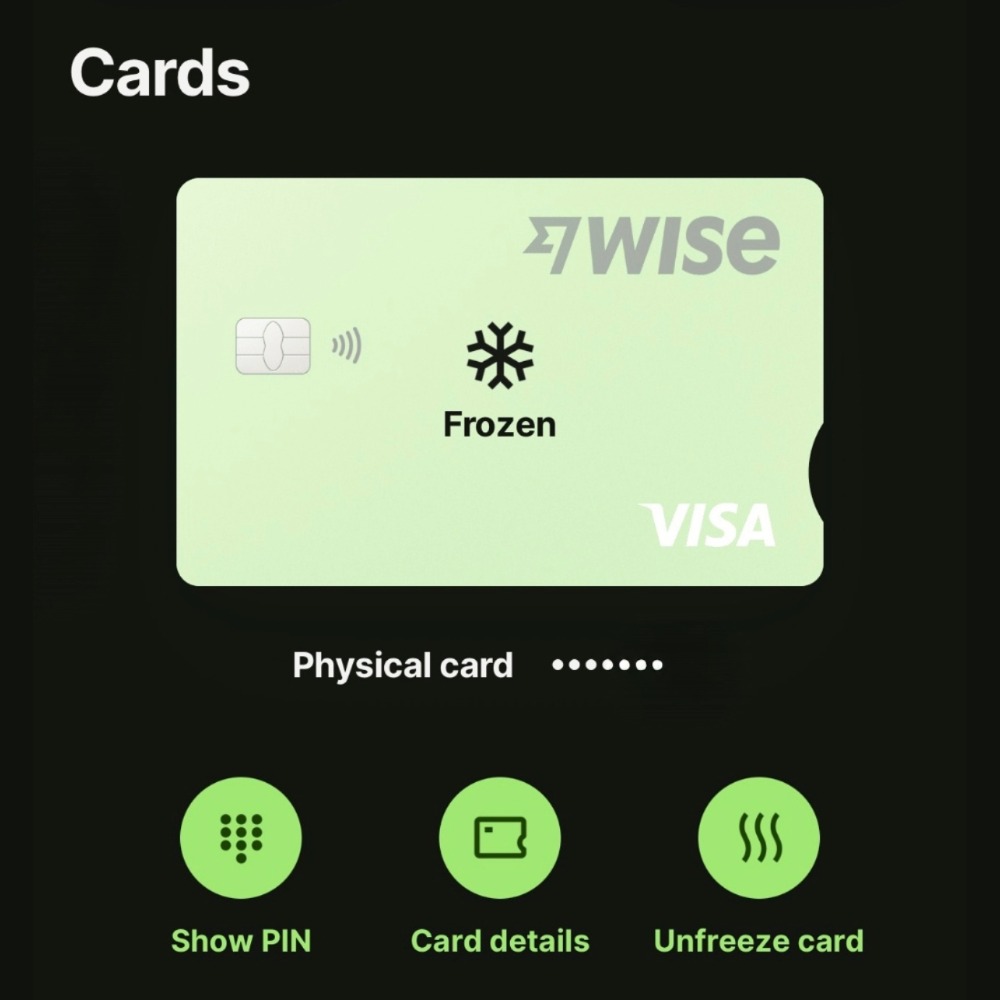
Major pro: You can freeze and unfreeze your Wise or Revolut card if it goes missing.
Better than having to call the bank to fully cancel your debit card, only to remember you put it in a hidden coat pocket on a winter night when your hands were too cold to open your purse, and it’s too late to un-cancel it. (Can you tell I’m speaking from experience?)
We also left our Revolut card at an ATM in Thailand once by accident, but we were able to freeze it until we got it back!
Summary: Wise vs Revolut for tourists in Canada
Personally, I use both Wise and Revolut for travel in Canada and everywhere else I go. It costs nothing beyond ordering the cards (unless you opt for a monthly Revolut subscription) and if you travel a lot, you can use them in Canada and beyond.
The only reason I’m going to call Wise the best card for tourists in Canada is that you can use Interac e-Transfer.
In terms of day-to-day spending at shops and restaurants in Canada, there’s no real difference between Wise vs Revolut. But they’re both suitable multi-currency travel cards for travel that are better than using your home debit or credit card when it comes to conversion rates and foreign transaction fees.
There’s one big consideration if you’re travelling with a partner: the Revolut joint account. Chesney and I use it all the time and it makes things really easy. We send money to the same shared Revolut account, but can manage everything in our own apps, and still have personal accounts.
For example, I can hold $100 NZD and $100 CAD in my personal accounts, plus €500 EUR in our shared. Or even $100 NZD in my personal account and another $100 NZD in our shared account.

No matter which multicurrency card you choose, always bring a regular bank card as a backup. Credit cards are the easiest and most reliable thing to use — and preferably Visa or Mastercard. American Express charges high fees for shop owners, so many businesses simply don’t accept it.
I’ve personally never had Wise or Revolut get rejected, but you might not be able to use one for a hotel or car rental deposit. A traditional bank-issued credit card is always better for that.
Wise & Revolut friend referral bonuses
If you found this article useful, I’d love if you use my referral link when you’re ready to get Wise or Revolut. (And if you didn’t find it useful, tell me in the comments what answers you seek!)
Your Wise sign-up perks depend on where you live. But it usually involves getting a free physical card or a discount on your first transfer. On the referrer side, I get £75 when three friends sign up. My friend referral link: Try Wise
Revolut’s referral program works a bit differently. Tbh I get way more money for referring you, but unfortunately I don’t think you get any perks for signing up. The referral bonus (for me) ranges from like £60 to £150 and changes all the time. Of course, if you ever get Revolut, you’ll get your own link to share with pals for a referral bonus.
My friend referral link: Try Revolut

Naomi Lai
Naomi is a Canadian travel editor and writer with 13 years of international travel across Southeast Asia, Europe, South America, New Zealand, and beyond. She covers everything from budget backpacking to luxury travel — always from personal experience.
More about Naomi