

If you have one or two weeks to visit Nepal, planning a tight itinerary is the best way to make the most of your visit. I spent 2 months across Kathmandu, Chitwan, and Pokhara, and they’re the best places to go for first-time visitors. Here’s how I’d break down a trip to Nepal if I had 1 week or 2 weeks.
This post may contain affiliate links. Bookings or purchases through these links generate a small commission for me at no extra cost to you. Thanks for your support!
1-week itinerary for Nepal
If you have 7 days to travel Nepal, you can’t summit Everest, but you’ll have time to explore culture around Kathmandu and spot wildlife in Chitwan National Park.
Day 1: Arrive in Kathmandu
Check in around Thamel and walk around the neighbourhood. Hopefully you’re not too jetlagged from the flight, because this part of the city is a lot. You’ll be dodging cars, scooters, rickshaws, and street dogs as you navigate the uneven streets. I recommend shoes with grip and closed toes. Oh, and you’ll also be offered hash like, a lot.
Find a good spot to try dal bhat for dinner, Nepal’s national dish consisting of rice, lentils, and an ever-changing variety of curries and sides.

Hotels in Kathmandu
Sapana Garden Thamel
A quiet little garden oasis that's still super central but a bit sheltered away from the unrelenting chaos of Thamel.
Check availabilityAarya Hotel & Spa
My favourite hotel in Nepal! The rooftop restaurant with glass floors has unparalleled views of the city.
Check availabilityDay 2: Durbar Square and Boudhanath
Hit Kathmandu Durbar Square and museum in the morning. It’s one of Kathmandu’s main activities, so it can get really busy as the day goes on and getting there in the morning means fewer crowds. That said, the indoor museum is a really nice reprieve from the heat. Your 1,000 NPR entry pass is good for the whole day, so you can come and go as much as you want.
When it’s time for lunch, we loved Breeze Rooftop Cafe & Bar. It’s on the top floor of a building right across the way with a view over the square.
The Kumari is a young girl worshipped as the living incarnation of a Hindu goddess, and she lives in the Kumari Ghar palace on Durbar Square. This one is the most famous and only appears briefly at a window inside the courtyard twice a day (usually around 11 AM and 3 PM).
Take a taxi to Boudhanath for sunset — this is the massive stupa you’ve almost certainly seen online when planning your trip. Pick a café with a stupa view, like Caravan Cafe.

Nomad eSIM is one of the only options for Nepal. We used Nomad and Maya Mobile throughout our trip and they both worked flawlessly. You’ll want an eSIM to access the internet wherever you are.
Day 3: Kathmandu Temples
Visit Swayambhunath (the Monkey Temple) in the morning to avoid the heat and crowds. You can walk there from the city centre in about 45 minutes or grab a taxi to the base. Then you’ll face 365 steps to the temple.
While cute, monkeys are unpredictable little monsters. Make sure you don’t have any open food in your backpack and keep your sunglasses and phone secure — they’ve been known to try and snatch stuff off unsuspecting tourists.
Head to Pashupatinath in the afternoon. This major Hindu temple complex is easily one of the most culturally significant places in Nepal. The inner-section is only accessible to Hindus, but it’s still worth visiting to explore the outside grounds if you’re not. You can see continuous open-air cremations along the riverbank — a profoundly spiritual and fascinating cultural experience.
Make sure you dress modestly for your temple-hopping day. This means covered shoulders, knees, and cleavage. There’s more guidance on Pashupatinath’s website, and you can apply this advice to any temple visit in Nepal.
Treat yo'self dining experience in Kathmandu: Krishnarpan
You’ll find the country’s best fine dining restaurant at The Dwarika’s — a 1 Michelin Key hotel in Kathmandu. Nepal has yet to receive any Michelin-star restaurants, but Krishnarpan is the next best thing.
As far as fine dining restaurants go, it’s very affordable. But compared to the average cost of a mid-range Nepali meal, it’s still incredibly expensive. The set menu will set you back around 10,000 NPR. If you’re a foodie and have the money, it’s a whole experience and so worthwhile.
We went and had an amazing time trying a range of Nepali dishes, from samay baji to Sherpa bread to mo:mo to dal bhat. It was a fun (and ok, slightly bougie) way to get introduced to Nepali food early on in our trip.
Day 4: Head to Chitwan
Escape the busy, loud, and crowded capital city to get some fresh air and see another side of Nepal at Chitwan National Park. The sweet spot for your visit is 2 nights/3 days.
Package tours to Chitwan make the whole thing really easy — organizing your transport, activities, hotel, and meals all into one booking. We had a good time overall, but there are some real benefits to booking everything yourself.
Take an early morning tourist bus or a short flight to Bharatpur (Chitwan). I really recommend the bus. It only takes about 6 hours and costs around 1,000 NPR one-way. Comparatively, a flight costs upwards of 15,000 NPR, and really isn’t that much more efficient when you consider you have to get to the airport, go through security, yadda yadda.
When you arrive in Chitwan, settle into your hotel (ideally in Sauraha). It will have some kind of evening activity, like walking down to the river to spot crocs and/or going to see a Tharu cultural performance in town. We spotted a mama and baby rhino out for a stroll on our way home from town on our first night — so fingers crossed for you!

Day 5: Full day in Chitwan National Park
Enjoy a quiet morning on the river in a traditional dugout canoe and keep your eyes peeled for crocodiles. I particularly loved the unusual gharial crocs that kind of look like cartoons to me. Had no idea these existed before getting here!
After hopping out of the canoe, your guide will lead you into the jungle on foot. We were lucky enough to spot a couple of rhinos lounging in the shade (at a safe distance of about 100m). Make sure you pack some binoculars for optimal viewing.
In the afternoon, go on a jeep safari through the national park. An experienced guide and driver will keep their eyes out, and you’ll likely see rhinos, crocodiles, and several varieties of deer. The safari will last about two or three hours, so you’ll have plenty of time for wildlife watching.
If elephant riding or a stop at the elephant breeding centre is on your activity list, opt tf out. It’s animal abuse and I kind of can’t believe people still do this. Fortunately, there are some ethical hotels in the park that don’t organize any elephant-related activities for guests.
Hotels in Chitwan
Hotel National Park
One of the only hotels that specifically focuses on ethical experiences and doesn't support elephant tourism.
Check availabilityBarahi Jungle Lodge
A luxurious base for nature lovers, with evening cultural dances, and quick access to safaris in the national park.
Check availability
Day 6: Travel back to Kathmandu
Catch an early bus back to Kathmandu. It takes about six hours, but traffic and delays are common. So expect to arrive sometime in the mid afternoon. From the bus station, take a taxi to Patan, rather than the hectic centre of Thamel.
We stayed at Temple House quite literally right next to Patan Durbar Square. It’s an old historic building with so much charm and it couldn’t be in a more central location. I wouldn’t stay there for a week, but for your last night in Nepal, it’s the perfect send off. (However, if you’re super tall, you might find it less comfortable — the ceilings are low and it’s a head-bumping risk.)
Day 7: Explore Patan
Consider calling up Sohan, a Patan local who hosts a morning walking tour. He’s so passionate and took us through what felt like secret passageways around the city to visit everything from temples to a mustard seed oil production facility, and even one of Nepal’s Kumari (different from the one who lives in Kathmandu Durbar Square).
As a woman, I struggle with the concept of Kumari — a “living goddess” who spends most of her childhood indoors, only to re-enter society when she has her first period. But it’s certainly fascinating, and it was interesting to visit her (Sohan took us in for a blessing). There’s more information on the centuries-old custom here.
Here’s Sohan’s Airbnb Experiences listing, but you’re better off contacting him directly on WhatsApp to cut out middle-man fees: +977 986 0344501
His tour covers the local side of Patan and doesn’t go to Patan Durbar Square, but you should definitely walk around the site on your own. It costs 1,000 NPR to enter, and your ticket includes museum access.
Budget tip: If you just want to casually walk around and see the historic buildings, go outside of the ticket booth hours of 9 AM to 6 PM, and you don’t have to pay.

Travel essentials for Nepal
📶 eSIM
Stay connected with internet access across Nepal (sometimes even in the mountains).
💸 TravelSpend
Track your Nepal budget easily (ft. a colourful doughnut chart with stats).
✈️ Seats.aero
Find and book flights with your points for Aeroplan, Lufthansa, Delta & more.
💳 Wise or Revolut
Compare the best multicurrency cards for ATM withdrawals and spending in NPR.
2-week itinerary for Nepal
With 14 days, you have more time to explore beyond Kathmandu and Chitwan. Travel west over to Pokhara, Nepal’s adventure capital and the jumping off point for hikes into the Annapurna Range of the Himalayas.
Days 1-3: Kathmandu
Arrive in Kathmandu and spend your first few days exploring Thamel and learning about Nepal’s history and culture. Follow the same first three days I laid out above in more detail.
If you’re doing any hiking, Thamel is lined with streets selling knock-off outdoor gear. (I got a great “Arc-teryx” jacket for my Mardi Himal trek and it cost 10,000 NPR.) That said, there are lots of outdoor gear shops in Pokhara, too.
The quality is obviously not as high as the real deal. So for major treks in harsh conditions, or any life-saving gear, I think it’s worth investing in a reliable brand. But if you’ve arrived unprepared and you need a warm jacket, gloves, hat, or whatever, the cheap imitations are absolutely fine. Kind of part of the fun of shopping in Nepal, if you ask me.
Day 4: Fly to Pokhara
Catch an early flight to Pokhara. Domestic airlines like Buddha and Yeti service this route at all hours of the day, so you’ll have no shortage of options. A one-way flight usually costs around 10,000 NPR to 20,000 NPR for foreign nationals. With two weeks, I recommend flying one way from Kathmandu and busing back — more on this later.
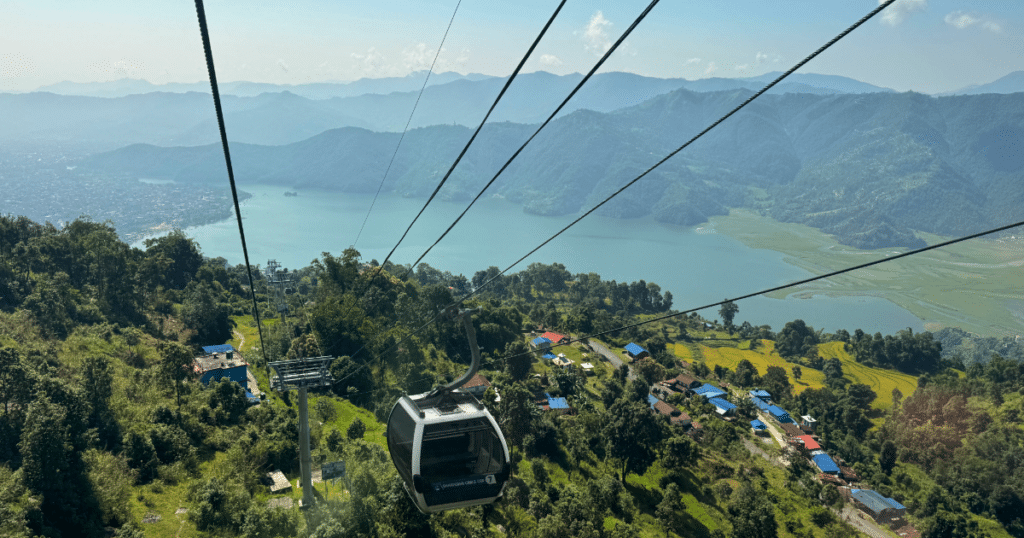
Settle in at your hotel and then spend the rest of the day exploring the Lakeside neighbourhood. If it’s a clear day, you might catch some glimpses of the Annapurna range from around the city. You could also get out on the water with a paddleboard or kayak if you’re up to it.
The Tipsy Tuna is the most underrated sunset spot in Pokhara. It was always empty when we went but has a pool, a nice cocktail list, and objectively the best views over the lake.
After dark, stroll along the lakeside towards “Disney Land” until you find someone serving fire-cooked chiya (chai tea). It’s literally just standard milk tea, but steaming hot, boiled in a cauldron over a wood fire and topped with some cinnamon and coconut powder for pizzazz. It’s a fun treat and just 100 NPR per cup.
Day 5: Fun in Pokhara
Pokhara is the adventure capital of Nepal, and you could squeeze a fair few activities into one day to make the most of your visit.
For one, Pokhara is an epic place to go paragliding, with views of Machhapuchhre and Phewa Lake as you soar through the skies. It’s also an exceedingly affordable place to try it at about 10,000 NPR, compared to 400 NZD in New Zealand’s adventure capital, Queenstown. (Tap the green amounts to see some current currency conversions to help you compare.)
If you want to take a skill home, we really loved our mo:mo cooking class with Love and Light — where proceeds from the class go directly to a children’s charity. It’s a good way to be efficient and bundle an activity and dinner into one.
There are also lots of places to drop in for a yoga class and limber up before your big hike.
Days 6-9: Mardi Himal trek
Mardi Himal is an epic 4-day hike you can do from Pokhara to a 4,200m viewpoint (4,500m if you add Base Camp). It overlooks Machhapuchhre, also known as Fishtail Mountain, which is easily one of the most stunning peaks in the Himalayas. The hike is on the hard end of moderate, but it’s not technical, and most days involve about 6 hours on the trail.
You can also push to finish the hike in 3 days, or take your time and stretch it to 5. We did 4 and I think it was the perfect middle ground. Here’s my full Mardi Himal itinerary and cost breakdown for details.
If Mardi Himal doesn’t sound like your cup of tea, check out Poon Hill (Ghorepani), which is a slightly easier 3-to-5-day alternative. Or if you’re just after an overnighter, Australia Camp is much easier and shorter and still delivers clear views of Machhapuchhre. In fact, you’ll pass through Australia Camp on the way to Mardi Himal.

Days 10-12: Chitwan National Park
This is the “more on this later” I promised back on Day 4 of this 2-week Nepal itinerary.
Flying one way to Pokhara and busing back to Kathmandu saves you an expensive domestic flight, and you can break the trip up with a stop in Chitwan National Park. Win-win! Take a morning tourist bus from Pokhara to Sauraha, which takes about 4 to 6 hours and costs around 1,000 NPR.
The key critters you’ll want to see in Chitwan are rhinos, crocodiles, deer, wild boar, cool snakes, and weird bugs like rhinoceros beetles. You’ll do a canoe ride, jungle walk, and afternoon jeep safari for prime wildlife watching opportunities.
(Jump back to the 1-week itinerary section for more about activities, logistics, and my hotel picks for Chitwan National Park.)

On Day 12, catch an early bus back to Kathmandu, which takes about 6 hours if traffic isn’t too backed up. You’ll arrive in the mid-afternoon. This time, skip Thamel and head straight to Patan instead. I recommend staying at Temple House or somewhere near Patan Durbar Square. It’s still busy, but far less hectic than Thamel and has a more local feel.
Temple House
We absolutely loved this quaint boutique hotel in an old, traditional Nepali building. With low ceilings and no real barrier on the old wooden windows, it's novel but best for a short stay. We had a great included breakfast every morning, and I'm not exaggerating when I say we were maybe 100 metres from Patan Durbar Square.
Best for: A unique stay on a budget
Skip if: You're over 6 feet tall
Day 13: Explore Patan
As mentioned in the 1-week itinerary section about Patan, you’ll get a lot of value out of a walking tour in this neighbourhood. Our guide Sohan is the go-to guy for a 10/10 experience. If you’re staying in the area, it’s also a must to visit Patan Durbar Square.
If there was anything you missed in Thamel, it’s just a 20-minute, maybe 500 NPR taxi ride away.
Day 14: Head back home
Say goodbye to Nepal, maybe going for one last stroll around Patan Durbar Square in the early morning when it’s still serene. Do any last-minute shopping for souvenirs before making your way to the airport. Namaste!
Souvenirs in Nepal
I’m not usually a big souvenir person, but I simply couldn’t stop buying stuff in Nepal. It’s full of so much great stuff to bring home.
Thamel has more variety when it comes to shopping. In some ways, Patan is better because the surrounding market stalls are more catered to locals rather than tourists and the prices are less inflated. Thamel, on the other hand, is lined by shops selling knock-off outdoor gear, flowy pants, rugs, singing bowls, wooden masks, and more classic touristy souvenirs.
In Patan, it was more artwork, wooden masks, ornate slippers, and brass shops, but absolutely no outdoor gear. Just something to be aware of if you had your sights set on anything in particular.
Here’s a TikTok post I made rating just some of the stuff I picked up over my two months in Nepal.


Naomi Lai
Naomi is a Canadian travel editor and writer with 13 years of international travel across Southeast Asia, Europe, South America, New Zealand, and beyond. She covers everything from budget backpacking to luxury travel — always from personal experience.
More about Naomi →
