
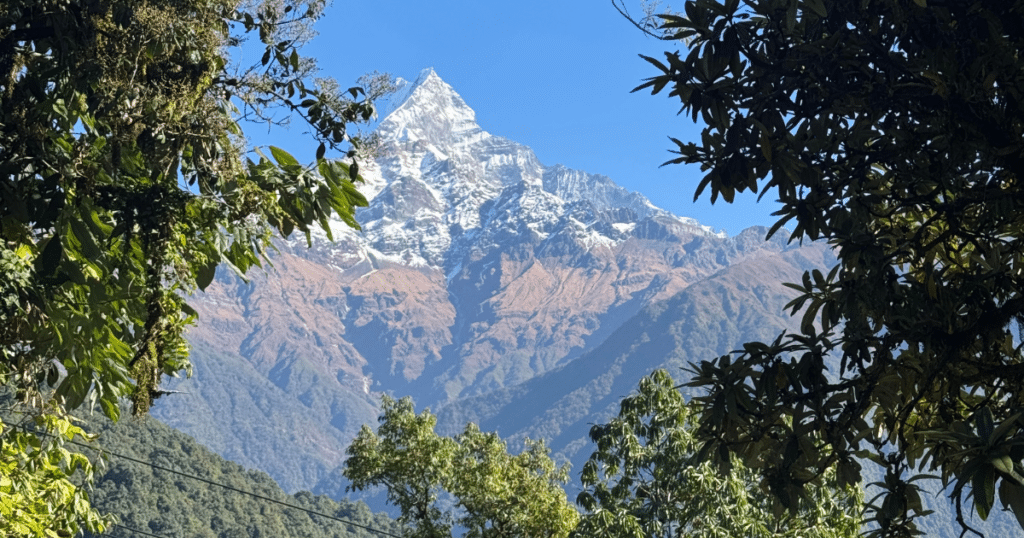
Nepal’s Mardi Himal trek wasn’t even on my radar until we got here. But this one kept coming up once we got to Pokhara and started looking at hikes under 7 days. You can do it in 3 to 5 days, and we ended up doing it in 4. The trail includes a lot of stairs, but it’s all worth it for the epic views of Machhapuchhre (also known as Fishtail Mountain) along the way. The highlight is reaching 4200m to catch the sunrise. Here’s what you can expect with a 4-day Mardi Himal trek.
This post may contain affiliate links. Bookings or purchases through these links generate a small commission for me at no extra cost to you. Thanks for your support!
Booking my Mardi Himal trek
It can be a little unclear whether you legally need a guide for Mardi Himal or not. The rules have changed a few times over the last five years. Regardless of what the current rules say, in my opinion, it just makes sense to go with a guide.
There are tons of activity providers lining the streets in Kathmandu and Pokhara, and every taxi driver will have a guy he knows who can take you trekking. But I think booking online is a nice, safe, and modern way to find a reputable guide.
This is the exact hike I booked with Get Your Guide. It was a private tour and we had the great Shiva as our guide and Ananda as our porter.
My Mardi Himal trek itinerary
Our actual itinerary didn’t end up identical to what it said on Get Your Guide. But with the advice of our experts, we trimmed down to 4 days so we could hit the best weather window for Mardi Himal Base Camp and the viewpoint.
It was definitely the right call, but it did require some 6-hour hiking days. So you need to be somewhat into hiking to actually enjoy this experience! Here’s exactly what we did in 4 days.
Mardi Himal Trek Day 1
- Shiva meets us at our hotel
- We catch the bus and then transfer to a public transport van
- 1.5-hour drive from Pokhara to Kande trailhead (1,700m)
- Quick stop at Australia Camp for great views
- Pass through Deurali (a popular overnight camp)
- Stop just before Forest Camp in Dur Kharka (2,500m)
- Total time on public transport from Pokhara to the trailhead: 1.5 hours
- Total hiking time from Kande to Dur Kharka Day 1: 6 hours

Our accommodation for Day 1
We stayed at A One View Hotel and Restaurant and the views for sunrise were truly epic. Like, you almost don’t need to walk to the viewpoint if you get a clear morning here tbh.
They also had wifi, charging ports in the rooms, and the option to have a hot shower. I also had decent cell reception up here with my Nepal eSIM.

The transport
The public transport portion of the journey definitely wasn’t what we were expecting. We’re truly not picky so we were happy to roll with it, but if you’re imagining a private car and want a private car, you can definitely check with the tour company first.
Transport is included, so we didn’t need to have any small bills for the bus handy — Shiva managed all of that.
Mardi Himal Day 2
- Up at 5:30 AM for sunrise and breakfast
- On the trail by 8 AM
- Pass through Low Camp (3,000m)
- Push on to High Camp (stay at High Camp 3,550m)
- Total time from Dur Kharka to High Camp: 6 hours
Our accommodation for Day 2
We stayed at Hotel Tiger Top, which does not have good reviews on Google as of Oct 2026 lol, but we had a nice stay.
It was legit magical at sunset overlooking Machhapuchhre. A group of Nepali students (and us, for a brief moment) danced in a circle as the sun went down. I’m not usually a fan of people bringing speakers on trail hikes… but this was an exception.

Mardi Himal Day 3
- 4 AM start to reach the Mardi Himal View Point (4,200m)
- Optional extra 45 minutes up and 30 minutes down to reach Mardi Himal Base Camp (4,500m)
- 3 hours down to Low Camp
- Continue on to Lwang (1,550m)
- Total time hiking: roughly 6 hours
*plus lots of time at the viewpoints

A nice perk of hiking to the Mardi Himal Viewpoint or Base Camp from High Camp is that you don’t have to bring any bags with you — just a light pack with some water and layers and you’re golden! It made the steep, unrelenting stairs much easier so early in the morning.
Our accommodation for Day 3
We stayed at Hotel Royal Mountain (simply listed as “Hotel” on Google Maps) and it was a memorable end to our Mardi Himal trek. We loved it, but I want to be brutally honest about the pros and cons to this one so you know what to expect.
This was a real slice of Nepal and full of charm. Buffalos and mules wandered right past our door, the mountain views were beautiful, and the owner’s young kids played a round of cards with us.
However, that same local charm meant we shared a plywood wall with the owner and her two kids, and the bathroom was a bit of a walk away, which was fine during the day but felt like a real mission in the middle of the night. (And keep in mind most toilets along the trek are squatters!) If you don’t mind and just want to support a local family running a small guesthouse, look no further.
There’s also the Hotel Mardi Thakali & Restaurant next door, which seemed a little more established and set up to be a hotel.

Mardi Himal Day 4
- Up at 6:30 AM, on the trail by 8 AM
- 2 hours downhill to Siding, where there’s road access back to Pokhara
- Hop in a shared Jeep (with one other hiker, her porter, and guide)
- Back at our apartment in Pokhara by 12 PM
- Total time on the trail: 2 hours
- Total time in the Jeep: 2 hours
The Jeep back to Pokhara
The Jeep drive back from the Mardi Himal trek is really pretty and a fun part of the experience but also super bouncy! Try to call dibs and sit on the left side if you can for the best views over the valley.
Note: We had to wait for another hiker to arrive before we could get in the Jeep. We were offered the option to pay an extra 4,000 NPR for private transport, but we weren’t in a hurry and decided to wait.
It was a little unclear how it all worked, and I think we only waited like 30 minutes so was not a big deal at all. (But like, would the other hiker have also had to pay for private transport because we’d left early?)
Keep some cash handy to tip your Jeep driver. About 500 NPR is reasonable for this ride.
Doing the Mardi Himal trek in 3 or 5 days
I think the 4-day Mardi Himal hike was the perfect length — enough time to soak up the mountains, challenge ourselves, and enjoy the views without feeling rushed.
But you can absolutely do the trek in 3 days if you’re a strong/avid hiker with limited time. It would mean going from 4,500m at Base Camp all the way down to Siding in one day, which is hard on the knees, but definitely possible.
On the other hand, if you’re not that into hiking and are doing this more for the views and vibes, you can take 5 days. That will break up the long stretches, but you’ll cover the same ground.

How much does it cost to hike Mardi Himal?
Here’s exactly what our private 4-day Mardi Himal trek cost for two people.
Tour operators price almost everything in USD, from the package itself to the porter’s daily rate and the recommended tips. And unless you have USD on hand, you’ll pay in NPR, so I’ve listed both. Tap or click the little green numbers to see current conversion rates.
- 400 USD Tour (typically includes guide, transport, accommodation, and all permits)
- 80 USD Porter ($20/day)
- 15,000 NPR Food & drinks
- 10,000 NPR Guide tips
- 5,000 NPR Porter tips
- 1,000 NPR Jeep driver tip
Estimated total per person: 340 USD / 50,000 NPR
*Based on an exchange rate of 150 NPR to 1 USD at the time of our hike in October 2026.
We also spent a few hundred rupees on small extras, like a charging block at High Camp for 350 NPR or bathrooms along the trail, usually 100 NPR.
While you don’t need to tip the Jeep driver 1,000 NPR, we didn’t have smaller notes, and he did keep us alive, after all.
Read more: Why I Use TravelSpend for Every Trip
How difficult is the Mardi Himal trek?
The most challenging part for me was just the STAIRS. It’s just a billion stone steps, not much trail. I do lots of walking and a fair amount of hiking, but omg make sure you hit the Stair Master before doing Mardi Himal in Nepal.
I’d classify it as the hard end of moderate. Like, it’s mostly uphill the whole way, and the push to the viewpoint and/or Base Camp on Day 3 are definitely gruelling in the dark. But it’s not at all technical (see: stairs).
Travel insurance for Mardi Himal
I use World Nomads for my travel insurance. Depending on your country of residence, you can add trekking as an adventure option for altitudes up to 6,000m.
Mardi Himal Base Camp is at 4,500m, so check what’s available for you and read the policy wording in full before you go.
World Nomads provides travel insurance. I’m a World Nomads affiliate, and I receive a fee for any quotes generated through my affiliate link.

Mardi Himal weather & when to visit
For ideal Mardi Himal weather and mountain viewing, visit in October or November. These are widely considered to be the best months for trekking in Nepal. Alternatively, go in the spring season in April and May to catch the rhododendron trees blooming.
The winter would be way too cold (at least for my liking) and requires more tactical gear for navigating snow. Avoid monsoon season from June to September. It’s not just the rain — it’s leeches, avalanches, and poor visibility. Where’s the fun in that?!
My trip is October couldn’t have gone better. We had full, crisp visibility every day. Temperatures were about 20 degrees during the day and dropped to around 10 degrees at night.
Packing for Mardi Himal & hiring a porter
Here’s what to pack for the Mardi Himal hike and why I think you should hire a porter.
What to pack for the Mardi Himal trek
Look, I don’t think I need to give you a comprehensive list of stuff to pack. There are lots of other pro hiking blogs out there, and your tour company will give you a list of suggested gear. You don’t need anything too fancy.
However, here are some essentials, including a few things that weren’t on the list the company provided. And one I wish I’d thought to pack!
- Sturdy hiking shoes. Standard for any hiking trip.
- Layers. Pack a base layer, a mid layer, and something like a down jacket that’s light but easy to take on and off. It was very cold at night even in October, so you’ll want warm clothes for the tea houses too.
- Rain jacket. Mountain weather can change fast so this is like a non-negotiable even if the weather looks clear and you never actually have to use it.
- Warm jacket. Required for when you’re standing still waiting for the sunrise. I got a nice knock-off Arc-teryx coat for 11,000 NPR in Pokhara that I really like and it did the trick. I’ll get to use it back in Canada, too.
- Gloves. You don’t really need them for hiking, just standing at the top waiting for sunrise.
- Chapstick. The air gets dry up there.
- Headlamp. Essential for the pre-dawn hike up to the viewpoint, and handy for finding your way to the bathroom at night in some tea houses.
- Aquatabs. Tap water at the tea houses is free, but treated or bottled water costs about 100 NPR to 350 NPR per litre. We got a box of 50 Aquatabs for 450 NPR, used them daily, and never had any tummy issues.
- Air-activated hand warmers. I wish I’d had these for my socks on the particularly cold nights. Like these thermopads.
- Hiking poles. These are definitely optional. Because there are so many stairs, they’re not actually that useful for most of the hike up. However, they were definitely an asset on the way down on the last day.

Hiring a porter
The above list sounds like a lot to carry in a day pack, right? So this is where your porter comes in. Hiring a porter for Mardi Himal is also a good way to put some money back into the local economy.
My partner, Chesney, and I ended up packing more than we expected. And the $20 a day (plus tip), split between the two of us, was more than worth it. However, if you’re on a really tight budget and have a big enough backpack, you could get away with carrying all your own gear.
Our porter, Ananda, was the best. Both he and Shiva were good chat on the trail and when we were hanging out at the tea houses.

If you want to book your trip with Shiva directly or see if Ananda is available, email me and I can share their details!

Naomi Lai
Naomi is a Canadian travel editor and writer with 13 years of international travel across Southeast Asia, Europe, South America, New Zealand, and beyond. She covers everything from budget backpacking to luxury travel — always from personal experience.
More about Naomi →
