

If you’re not using an eSIM to travel in 2026, it’s time to hop on board! It’s game-changing tech that’ll stop time wasted hunting for questionable wifi. I recently tried a Roamless eSIM on a trip to Thailand and loved it. Here’s my review of how the data and calling functions work, its pricing structure, how it compares to other eSIM providers, and the overall pros and cons.
This post contains affiliate links. Booking through these links generates a small commission for me at no extra cost to you — in this case it actually gives you a discount! Thanks for your support.
Roamless eSIM highlights
- Roamless is a global eSIM that works across countries without swapping plans.
- Roamless Flex is the unique pay-as-you-go data that never expires. Roamless Fix gives you a cheaper set data bundle for 30 days.
- Make in-app calls to landlines and cellphones.
- New feature Roamless Numbers give you a dedicated US, UK, Canadian, or Australian number.
- Flexibility makes a Roamless eSIM deal for layovers, spontaneous travel, and short trips.
About my Roamless review
I wrote this Roamless eSIM review after testing it over a month in Thailand (and a bit of Canada). Connectivity wise it was flawless. It worked as soon as I activated it in Canada and was connected to the local network in Thailand as soon as we landed. Like, before we even got off the plane.
Roamless provided Flex credit for the test, and I bought a Fix plan of 20 GB for 20 USD to extend how long I’d be able to use it in Thailand. And just to give you a more well-rounded, honest take, ya know?
I had an overwhelmingly positive experience. It was so easy to use, and I actually struggled to find cons to include in this Roamless eSIM review.
How does Roamless work?
Basically, a Roamless eSIM lives in your phone instead of the physical chip you’re used to. (They can live in harmony as well, but you don’t have to remove your home chip.)
You just download the one eSIM and get connection no matter where your travels take you. If you have credit, it’ll work as soon as you arrive. Our plans change all the time, so having that global credit means we’ll always have connection.
And one unique thing I really love about Roamless is that your credit never expires. Another, is that you can use the app to call landlines (rare af). More on all of this below.
When and why you need an eSIM
Getting online when arriving in a new country used to be a whole ordeal. Here’s what my arrival routine actually looked like:
- Frantically screenshotting my Airbnb address (usually just before boarding, because I’m forgetful).
- Landing and hunting for reliable airport wifi to call an Uber or look up public transport options.
- Queuing at a phone store to buy a physical SIM.
- Deciphering data packages through a language barrier/new currency.
- Fumbling with that tiny metal pin to open the SIM tray.
With an eSIM, the whole thing now looks like this:
- Install my eSIM before I leave home.
- Toggle it on in my settings when I land (or even earlier because Roamless Flex works globally).
- Walk into the airport arrivals hall with data already running basically feeling like a local.
I once even helped a girl in Bali who had called a Grab (Asia’s Uber) with airport wifi but lost connection at the pickup point. I was able to give her a quick hotspot so she could contact the driver. Easy peasy.
Is Roamless legit?
Roamless is totally legit. I put it to the test in Thailand.
And if my review isn’t enough to instill confidence, I won’t take it personally, I’m basically a stranger. But there are thousands of glowing Roamless reviews by other strangers on Trustpilot. Last I checked, (August 2026), Roamless had an average 4.5-star rating and over 1,600 reviews. I think this one sums it up pretty well:
“The simplicity is key. Drift form one country. To the next and there is no disruption to connectivity. Topping up is quick and simple too. Overall this has worked so much better than expected and far better that individual country eSIMs where anything left is wasted cash.” — Mr. John Odwell on Trustpilot (March 2026)
The company is headquartered in San Francisco and has been around since 2023.

Roamless eSIM prices
Roamless Flex (pay-as-you-go) can be relatively expensive per GB. But the flexibility (as implied) is the trade off. The credit never expires. So you can use it wherever you are before you pick a Fix plan. Note you’ll also need some Flex credit to make calls — Fix is data-only. I’ve listed all the prices in USD for easier international reference, and they’re accurate as of August 2026.
Here are some Fix price examples for different locations/regions:
- Thailand 10 GB: $10.95 ($1.10/GB)
- Spain 10 GB: $13.95 ($1.40/GB)
- Italy 10 GB: $18.95 ($1.90/GB)
- Mexico 10 GB: $18.45 ($1.85/GB)
- Europe 10 GB: $30.95 ($3.10/GB)
Flex credit prices change depending on where you are in the world. But Flex is generally $2.45 per GB. Some examples of Flex credit outliers:
- Mexico $2.95/GB
- Kyrgyzstan: $9.95/GB
- Belize: $14.95/GB
- Afghanistan: $17.45/GB
- Vanuatu: $17.45/GB
So as you can see, it’s mostly remote or lesser-visited countries where the price per GB skyrockets. If you’re travelling around Europe, Southeast Asia, and North America, you’ll mostly be paying the $2.45 rate. Or, better yet, getting a Fix plan to bring the cost down closer to $1.
Want to try it? Use my Roamless promo code, RUNAWAY20, for 20% off your first plan. It’s one of the best discounts you’ll find. And they’ll give you a $5 credit bonus when you refer a friend!

Roamless eSIM Flex vs Fix
Roamless has two plan types: Flex (pay-as-you-go) and Fix (traditional data packages). I used both together. And it’s the smartest way to do it, if I do say so myself.
Roamless Flex
Flex credit works globally and never expires — this is the unique Roamless pay-as-you-go model. It’s billed per GB, so it’s ideal for layovers, short stops, or anywhere you don’t need a lot of data.
We did an 18-hour layover in Singapore, and a Flex package is perfect for that kind of speed run. Choose too small of a Fix plan, like 1 GB, and you might run out. Choose too much, like 5 GB, and it’s money wasted. Flex will just charge you for exactly what you use when you’re passing through.
Roamless Fix
Fix plans come in set bundles from 1 GB to 20 GB and work for a specific country or region. For example, if you’re bouncing around Southeast Asia, you can get a Fix package for 20 countries including Thailand, Cambodia, Vietnam, and Laos.
Unlike Flex, these packages are only valid for 30 days, but the per-GB rate is significantly cheaper.

Using both Roamless eSIM types: Flex and Fix
Yes, you can use both! When you have Flex and Fix active, Roamless automatically draws from your Fix plan first, then falls back to Flex if you run out. It’ll also warn you when your Fix package is running low or nearing its expiry date.
I used a combo of the Roamless Flex and a Roamless Fix plan for the best of both worlds: flexibility and price.
A Fixed package for a country/region works out to be cheaper per GB than Flex. I started with Flex credit in Canada a few days before I left just to make sure it was all set up and working smoothly, which it was. When I landed in Thailand and switched off airplane mode, I was instantly connected to the local network.
Then, once I was settled in to my hotel, I got a Fix 20 GB Thailand plan for 30 days, saving me $1.45 per GB.
The Fix plan works out to about $1.1/GB compared to $2.45/GB with Flex. And I still have Flex credit I can use whenever I need it, and it won’t expire. I switch it on temporarily for landline calling sometimes.

Do I recommend Roamless eSIMs?
So, is Roamless worth it? In my experience, yes. And this Roamless review wouldn’t be complete without highlighting what I consider its most standout feature: in-app calling. Roamless has a VOIP system that will remind you of how Skype used to work (RIP).
You might think you don’t need it and can just stick to Whatsapp — you’re mostly right. But there are bound to be some occasions where you want to make a reservation over the phone, call your bank back home, or call a landline — such as when you forget your card at an ATM in Thailand… (*ahem*)
Anyway, most eSIMs don’t let you do that.

To be fair, ETravelSim offers texting and calling on many plans, and aloSIM works with Hushed to give you a phone number when you’re abroad. Jetpac Voice is another calling feature that works in 50 countries — but credit expires for all of these competitors.
With Roamless, I called Canada and New Zealand from Thailand for $0.04/minute and couldn’t believe how easy it was. The connection was also super clear and I could hear everything perfectly fine.
Note: per-minute prices vary quite a lot (up to $0.30, I believe) depending on where you’re calling. But the app makes it clear. I still have $45 in credit that I can use for GBs or calls and I don’t need to worry about that disappearing.

Roamless vs Jetpac pricing structure
Roamless Numbers
They’ve also just launched Roamless Numbers — a feature that takes it even further. You can now choose a dedicated phone number in the US, UK, Canada, or Australia for international calls, texts, and free Roamless-to-Roamless messaging.
Pick your number in the app, choose a monthly (US $6.95) or annual (US $59.45) plan, and you’re good to go. This is a pretty big deal and makes Roamless a more well-rounded communication tool rather than a data-only eSIM.
For example, this actually makes it a viable option to set up for 2 Factor Authentication so you can receive verification codes for logins. (Common for your bank to send you at the most inconvenient of times.)

Roamless vs Airalo
Airalo is the most famous eSIM company out there, and brands itself as “the world’s first eSIM store.” But first doesn’t always mean better.
I don’tt think Airalo is worth it due to my own experience, reliability issues, a lame refund policy, and poor reviews. Not to mention my affiliate experience, which I touch on in this Airalo review article. (I appreciate them for making eSIMs mainstream, though.)
| Roamless | Airalo | |
|---|---|---|
| Pricing model | Pay-as-you-go | Fixed data packages |
| Data expiry | ✓ Never expires | ✗ Expires with plan |
| Works across countries | One SIM works anywhere | New plan needed for each region |
| Hotspot | ✓ with Flex credit | ✓ some plans |
| Calling | ✓ Yes | ✗ No |
| Referral bonus | $5 credit | $3 credit |
| Get Roamless (20% off) | Get Airalo |
Quick comparison: my experience with Roamless vs Airalo
Airalo worked fine the first time I used it for a 3-day trip. But the issues started when I tried to rely on it for 3 months in South Africa. It worked for a month then broke down when I topped-up. Support was slow and never found a solution, and they refused to refund the unused 30 days I’d just paid for. (I eventually got credit, but it took a lot of convincing.)
My Roamless eSIM took like a minute to set up. And it worked seamlessly for a few days when testing it in Canada before we left, and over a month in Thailand. Because of the “Flex” plan, it worked the moment I touched down on the plane. Perfect — no notes.
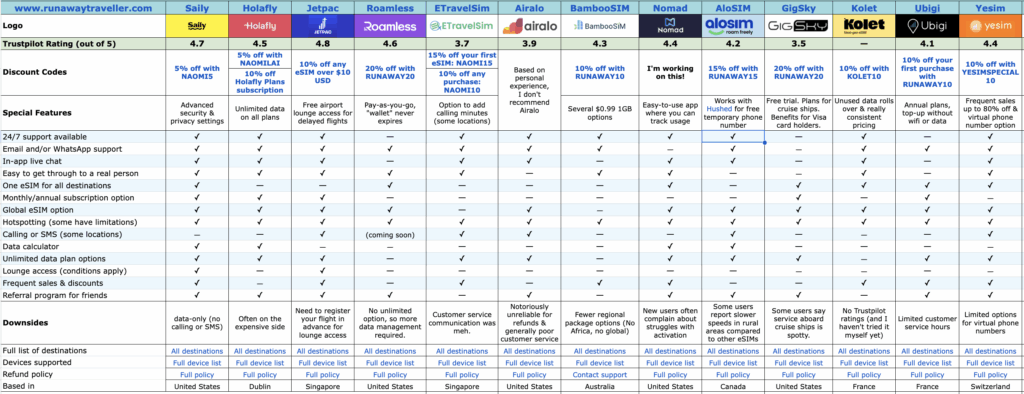
I went all-in on this eSIM comparison spreadsheet to help you weigh up all the features and benefits of Roamless and 13 other providers. Promo codes and all. And who doesn’t love a spreadsheet?
I update it regularly, but things change quickly. So make sure you double check info with the eSIM provider before you commit.
Take this quick eSIM quiz!
I’ve designed this little six-part questionnaire to help you find the best eSIM among my five favourites: Roamless, Saily, Holafly, aloSIM, and Jetpac. They all offer a little something different, so here’s which one is probably best for you, depending on your trip and travel style.
How long is your trip?
How much data do you realistically use while travelling?
How do you prefer to pay for data while travelling?
Do you need a phone number while travelling?
What matters most when choosing an eSIM?
Where are you travelling?
Roamless pros and cons
The pros of using a Roamless eSIM definitely outweigh the cons. However, here’s what you should consider before you commit.
Roamless eSIM pros
- It’s one of the only pay-as-you-go eSIM options. Flexibility when you travel is the best.
- Roamless makes it super easy to make in-app calls to a landline or cellphone. And you never know when you might need this. You can even have it installed alongside another eSIM and only use it for calling.
- Roamless Numbers is an awesome long-term travel feature. You don’t have to rely on FB Messenger and Whatsapp.
- Flex credit never expires. Nothing worse than wasting money on unused GBs or calls you didn’t make.
- You can activate it as soon as you arrive in a new country — or even before! Because it’s one eSIM that works anywhere (with Flex credit), it’ll connect in a new location without you needing to install a new eSIM. Convenient af to have data as soon as you land.
- You get 20% off your first purchase with my promo code: RUNAWAY20. It’s the highest introductory discount of any eSIM I’ve tried.
Roamless eSIM cons
- RoamlessFlex credit can end up being expensive. The per-GB price is more than what you pay for Fix plans, especially if you’re a heavy data user. Using a combo of Flex and Fix is the way to go IMO.
- Roamless Numbers may be confusing if this is your first eSIM. If you’re not particularly tech-savvy or just want a phone number for a short trip, you might feel overwhelmed by the subscription model.
- Customer support isn’t 24/7. There’s a chat bot on the app or Roamless website. It let me request a “human agent” quickly, and it took <10 minutes for a person to reply. Otherwise, the only way to contact the team is via email: support@roamless.com
- Currently, you can’t buy Fix data plans with your existing Flex credit. However, I believe a change is in the works.

Naomi Lai
Naomi is a Canadian travel editor and writer with 13 years of international travel across Southeast Asia, Europe, South America, New Zealand, and beyond. She covers everything from budget backpacking to luxury travel — always from personal experience.
More about Naomi →
